




-By Nyein Nyein Pyae
Min Aung Hlaing does not want the presidency in order to leave military rule behind. He wants it because the military-capitalist bloc is trying to salvage its system of domination from a crisis of its own making. Above all, he needs it to save himself.
He fears that losing office will mean losing impunity—and that losing impunity could mean being held accountable. He also fears that, at the decisive moment, the military institution may decide he has become a liability and remove him in order to preserve its own power and impunity. He has therefore sought to shape the redistribution of the regime’s top posts on his own terms, placing loyalists across the commanding heights of power.
What Min Aung Hlaing, the military institution, and the military-capitalist bloc around it all fear is the same unraveling: the erosion of command, territory, legitimacy, extraction, privilege, wealth, and impunity. What they are searching for is not a path out of authoritarian rule, but a way to slow their decline without surrendering power. What they are staging now is not transition, but the appearance of transition: a new shell for the same old order of coercion, plunder, and impunity.

Public Service Announcement
For Min Aung Hlaing, the presidency is not a neutral constitutional office. It is a political bunker: a shell designed to protect impunity, manage rivals, entrench his grip on power, and repackage military domination as state order. It is more flexible, more saleable, and more politically usable than naked junta rule. He reaches for it not from strength, but from within a historic failure of military rule.
●The UCC and the laundering of domination
The clearest institutional sign of this project is the regime’s new Union Consultative Council, or UCC, law, enacted by the National Defence and Security Council in February 2026 and signed by Min Aung Hlaing as Acting President. The law matters not because it creates a ceremonial advisory body, but because it enlarges the political reach of the presidency—and, through it, the military—across the regime’s key sites of power.
Under the law, the President is empowered to form the Council, appoint its members, designate its chair and secretary, define its duties and powers, and place its office under the President’s Office. Its remit spans union security and the rule of law, international relations, peace affairs, and legislative affairs. These are not peripheral domains.They are the core terrain on which military rule is coordinated, defended, and legitimized. A body constituted this way does more than advise. It gives the dictator’s presidency a formal mechanism for coordinating decisive branches of rule while still speaking the language of constitutional order.
Even the law’s insistence that this authority is exercised “without encroaching upon” executive and judicial power is politically revealing. The disclaimer functions as constitutional camouflage. It preemptively denies the very objection the law invites: that the presidency is being equipped to reach across domains that are formally supposed to be separate. In that sense, the law reveals more than a simple power grab. It shows the regime stretching even the formal architecture of its own military-scripted 2008 constitutional order while trying to preserve the appearance of fidelity to it. The point is not separation of powers, but the managed concentration of control behind constitutional language.
That is why the dictator’s move to the presidency matters more than the commander-in-chief title alone. It offers a higher office from which military domination can be redistributed through the state rather than exercised only through the barracks or the blunt machinery of junta rule. It allows authoritarian power to appear less naked, more procedural, and more legible to neighbors, diplomats, investors, and transition brokers. What is being constructed here is not a democratic transition, but another mechanism for preserving military rule in a time of crisis.
● The presidency as Min Aung Hlaing’s shield
Min Aung Hlaing grasps for the presidency because he cannot safely leave power. He is not merely tied to the regime’s grave crimes; he is their chief architect and principal perpetrator. Under those conditions, his actions make clear that he clings to power as the only protection he has left.
For him, office is not only a means of rule. It is also protection. To lose it would mean losing control over the institutions that have helped shield him, his family’s exploitative wealth, and the patronage networks around him. It would also mean greater exposure to forms of reckoning long deferred by power.
The commander-in-chief position has long served as his protective wall. It has given him hierarchy, armed force, and a chain of command through which accountability can be buried beneath obedience. But it is also the office most visibly marked by genocide, war crimes, crimes against humanity, mass repression, and command responsibility. The presidency offers another route to insulation: a higher office wrapped in constitutional language.The point is not simply to prolong his tenure. It is to preserve impunity under another name.
It also offers protection against danger from within. Once he gives up the commander-in-chief title, he risks losing direct control over the hierarchy that has sustained him. New commanders may build power bases of their own. Officers may distance themselves from his failures. Internal factions may conclude that the institution can preserve itself more easily without him. Under those conditions, the presidency becomes a shield not only against accountability from outside, but against disposal from within.
It also offers another route to manufactured legitimacy. Rather than appearing as a president elevated directly by the military bloc in the regime’s sham parliament, Min Aung Hlaing seems intent on being presented as an “elected” president nominated through the Pyithu Hluttaw (Lower House). The point is not democratization, but political laundering: a new constitutional script for the same military domination. The office is therefore not merely a personal ambition. It is a survival mechanism for a dictator who cannot safely relinquish power and cannot trust the institution around him to protect him once he no longer commands it directly.
● A military in institutional and structural crisis
But Min Aung Hlaing’s personal insecurity is only one layer of the problem.The presidency matters because the military institution itself is trying to rescue an oppressive order it has driven into crisis.
The Myanmar military is not a neutral body caught in unfortunate instability. It has repeatedly produced crises through domination, coercion, and war against the very society it claims to protect. It has long cast itself as the guardian of the nation while destroying the social and political basis of any genuine political resolution. It has claimed to preserve the Union while escalating atrocity, deepening armed conflict, and blocking any federal, democratic, and emancipatory transformation. The current crisis is not something external actors imposed upon an otherwise coherent order. It is the accumulated result of military rule itself.
The 2021 coup sharpened that contradiction. In trying to seize total control, the military damaged the very mechanisms through which it had previously maintained domination. It shattered what remained of its mediated legitimacy, ruptured older channels of accommodation and fear, and exposed itself more nakedly as an occupying force over society.
This is not only a political and military crisis. It is an institutional one. The post-2021 war has narrowed the channels through which military rule once stabilized itself through patronage, protected accumulation, and command over the center and periphery.The question is no longer simply who occupies the top office. It is how military domination can be preserved when the old structure has become too exposed, too costly, too unstable, and too discredited.
That crisis runs deeper still, into the reproduction of military rule itself. Coercive orders do not survive by force alone. They also depend on routines of obedience, networks of mediation, ideological cover, and material arrangements that allow domination to reproduce itself. Those foundations have been badly damaged.
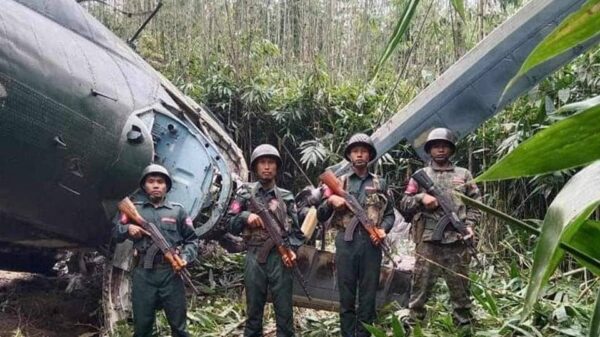
The resistance that followed the 2021 coup did not remain confined to the borderlands. Because of the military’s inhumane oppression, mass protests were transformed into armed resistance nationwide, including in the central plains. That marks a historic break between the military and the social terrain from which it long drew recruits, nationalist legitimacy, and a major part of the foundation for reproducing its power. What is breaking down is not only territorial control, but the social and ideological ground through which military rule once renewed itself.
The turn to violent conscription exposes that breakdown sharply. It reveals fractures in the circuits through which military rule long reproduced itself: recruitment pipelines, patronage networks, ideological habits, and the household labor that absorbed the costs of war and militarization. When those circuits fracture, the regime loses more than legitimacy. It loses part of the machinery through which coercive rule renews itself.
This is why the regime’s violence has intensified as its position has weakened. Repression widens because older methods of rule are failing. Conscription reveals not confidence, but weakness. Terror expands because command has become less secure. The presidency belongs to that same logic. It is not a departure from repression, but another shell around it. Then, it offers a mechanism through which military power can be redistributed and preserved while permanent emergency rule is dressed in constitutional form.
● The military-capitalist bloc
This is not only the story of one man’s fear or one institution’s crisis. It is the story of a ruling bloc trying to preserve itself.
Min Aung Hlaing’s position is fused with the interests of a military-capitalist bloc: generals, military conglomerates, cronies, contractors, extractive capital, border-trade brokers, land grabbers, and the parasitic social layer that feeds on authoritarian stability. This bloc does not merely benefit from the state. It is organized through the state. Its wealth is built through monopolized access, coercive protection, dispossession, and armed privilege. It accumulates not despite repression and war, but through them.
The post-2021 revolution against military rule has made that military-capitalist order harder to sustain. But the strain now confronting the regime is not the product of resistance alone. It is also the result of the military’s own rule: economic mismanagement, widening war,
repression, and the predatory destruction of the social conditions on which extraction and patronage once depended.Trade routes have been disrupted. The currency has been battered by regime mismanagement. Capital has become more evasive. The regime’s cronies and their businesses have also faced public boycott.
The regime’s ability to channel extraction from borderland and regional economies through the center has weakened. For the regime, the problem is not only that it has fewer resources. It is that the old order of extraction and patronage has become harder to reproduce.
That pressure is felt across the military-capitalist bloc that has long depended on this system. This bloc must be named clearly. It is not merely an elite in some neutral sense. It is a predatory alliance of military command and capital. Its profits depend on denied rights, oppressed unions, seized land, militarized trade routes, extractive concessions, opaque contracts, and the subordination of laboring and dispossessed classes.
The presidency matters because it attempts to protect the political-economic machinery that secures this accumulation. It is part of a strategy for preserving wealth above while pushing the costs of crisis downward. War, inflation, displacement, forced recruitment, debt, dispossession, and social ruin are borne by ordinary people. The ruling bloc, meanwhile, seeks to keep privilege intact. It socializes ruin downward and privatizes protection upward.
This is not just dictatorship. It is class rule organized and defended through armed force. The presidency is therefore not only about personal survival or institutional redesign. It is also about the social order that military domination has long secured.
●Not transition, but the laundering and reconstitution of rule
Above all, Min Aung Hlaing is trying to save himself. He grasps for the presidency because he is insecure on every terrain that matters. The fascist military is also trying to save itself as an institution. It faces further erosion in command, territory, cohesion, legitimacy, resources, and its capacity to reproduce domination. And the military-capitalist bloc is trying to save the order that has protected its interests. It fears the weakening of the machinery of class rule that has long secured its wealth, privilege, extraction, and impunity. What binds these crises together is not any shared commitment to peace or order, but a common need to arrest decline without surrendering power.
That is the real meaning of the dictator’s presidency and the sham transition the regime is now staging in Myanmar. This is not a departure from military rule, but an effort to salvage it in a new form. Their project is not to dismantle military rule, but to repackage it; not to democratize the state, but to reorganize control across it; not to yield authority, but to preserve it within a more saleable constitutional shell.
Min Aung Hlaing cannot recover real legitimacy. He cannot create consent through repression. But he can fabricate its appearance. Presidents, parliaments, cabinets, constitutions, elections, and staged procedures become useful here not as instruments of democratization, but as political theater. Their function is to launder domination.
That is why the language of transition must be rejected. No transfer of power is taking place. What is being normalized is domination given new legal form, wrapped in new procedure, and marketed as transition. The presidency is politically crucial because it concentrates three forms of self-preservation at once: personal protection for Min Aung Hlaing, institutional reorganization for the military, and class protection for the military-capitalist bloc. No one should mistake this for moderation. What is being sought is not peace, reconciliation, democratization, or an exit from authoritarian rule. It is the reconstitution of military-capitalist rule under a new sovereign mask.
The core logic remains the same: impunity above, repression below; privilege above, ruin below; ceremony above, coercion beneath. Min Aung Hlaing does not grasp for the presidency in order to leave military rule behind. He grasps for it so that military rule can outlive its crisis, reappear in a new form, and continue protecting those who built it—himself first of all.
(Nyein Nyein Pyae is a journalist and civil rights and social justice activist whose work opposes military rule in Myanmar.)
